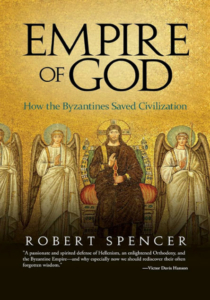
An excellent review by Bruce Bawer of my latest book, Empire of God: How the Byzantines Saved Civilization.
“Empire of God: Robert Spencer’s new masterpiece unveils how the Byzantines saved civilization,” by Bruce Bawer, FrontPage Magazine, December 14, 2023:
[Order Robert Spencer’s new book. Empire of God: How the Byzantines Saved Civilization: HERE.]
Founded as a kingdom in 753 B.C., Rome became a republic in 509 B.C. and an empire in 27 B.C By the fourth century A.D., the empire was so huge – extending from present-day Scotland to the Persian Gulf – that it was decided to divide it, for administrative purposes, in half, with one capital (and one emperor) at Rome and another at Constantinople. Most reasonably educated people in the Western world today are aware that our civilization began with Rome, and had its antecedents in Athens and Jerusalem. If we went to decent schools, we acquired at least some awareness of Rome; some of us read Virgil’s Aeneid, Shakespeare’s Antony and Cleopatra and Julius Caesar, Shaw’s Caesar and Cleopatra, and Robert Graves’s I, Claudius; those of us with a fondness for old movies have seen Roman epics like Spartacus and The Robe and Quo Vadis? We know that while the Greeks were big on philosophy and drama and art, the Romans were more practically inclined, constructing massive arenas and aqueducts, not to mention a number of roads that are still used to this day. No, we’re not experts on Rome, but it’s a part of our consciousness. Indeed, a series of postings on social media that were widely shared just a few weeks ago suggested that a not inconsiderable percentage of American men think about the Roman Empire several times a day.
But what are they thinking about when they think about Rome? Almost invariably, they’re thinking about the Rome that had its capital in the city of that name – the Rome, that is, of Caesar, Caligula, Claudius, and Nero. But if the empire centered at Rome – first, the united empire, and then the western empire – is very much alive in our consciousness, the eastern empire, which was ruled from Constantinople, isn’t. When we think about the timeline of history, that empire may well fall often between the cracks: we don’t know much about it; we don’t have much of a sense of it; we can’t picture it. If we think of the people of the western part of the empire as our forebears, we think of the eastern part as exotic – almost as alien, perhaps, as ancient India or China or Japan. And yet, as Robert Spencer writes in his magnificent, eye-opening new book, Empire of God: How the Byzantines Saved Civilization, the eastern part of the empire is also a central part of our heritage. Whereas the western part lasted barely a century after the east/west split, the eastern empire went on for more than a millennium. Today we know it as the Byzantine Empire, but in its day, during all those centuries after the city of Rome fell, what remained of the empire in the east was known simply as the Roman Empire, and Constantinople was, to all intents and purposes, the New Rome.
Constantinople, of course, was founded by and named for the Emperor Constantine, who ruled from A.D. 306 to 337, and whose personal conversion to Christianity was crucial to the establishment of that faith as the majority religion throughout the western and eastern parts of the empires. During his reign of a year and a half (361-363), Julian the Apostate, who worshiped Jupiter, Apollo, Venus, and all the other old deities, used strongarm tactics in an attempt to turn around the empire’s Christianization. Crisis came under Valens (364-378), who made the mistake of inviting Goths (who’d been conquered by the Huns) to settle in Thrace; soon enough, in the Romans’ most catastrophic defeat in centuries, the Goths turned on their hosts with “unspeakable savagery,” slaughtering them en masse in a years-long war that ended in Roman capitulation: ultimately, the Goths were permitted to remain in Thrace on their own terms, maintaining their distinctive culture rather than conforming (as had long been the expectation) to Roman norms. Spencer’s account of this nightmarish chapter brings to mind several current situations – the recent Hamas massacres and their aftermath, the ongoing Islamization of Europe, and the daily flow of illegal aliens across America’s southern border – and carries a chilling lesson for all those who look upon such matters with nonchalance. It was, by the way, Rome’s ill-advised immigration policies that were the principal cause of what has long been known as the “fall of the Roman Empire” in A.D. 476 – even though, as Spencer notes, the events of that year have long been misunderstood. “The unfortunate phrase ‘Fall of the Roman Empire’ has given a false importance to the affair of 476,” wrote historian John Bagnell Bury in a passage quoted by Spencer. “But no Empire fell in 476; there was no western empire to fall. There was only one Roman Empire.” And it lasted until 1453.
There is more. Read the rest here.
aum says
Interesting.
Parallel of immigration in to Europe worth noting with the fall of western Rome with Goths,