What happens when you subject a country to 40 years of draconian Sharia rule? A 99% Muslim country becomes 40% Muslim.
“Iran’s secular shift: new survey reveals huge changes in religious beliefs,” by Pooyan Tamimi Arab and Ammar Maleki, The Conversation, September 10, 2020:
…In June 2020, our research institute, the Group for Analyzing and Measuring Attitudes in IRAN (GAMAAN), conducted an online survey with the collaboration of Ladan Boroumand, co-founder of the Abdorrahman Boroumand Center for Human Rights in Iran.
For our survey on religious belief in Iran, we targeted diverse digital channels after analysing which groups showed lower participation rates in our previous large-scale surveys. The link to the survey was shared by Kurdish, Arab, Sufi and other networks. And our research assistant successfully convinced Shia pro-regime channels to spread it among their followers, too. We reached mass audiences by sharing the survey on Instagram pages and Telegram channels, some of which had a few million followers.
After cleaning our data, we were left with a sample of almost 40,000 Iranians living in Iran. The sample was weighted and balanced to the target population of literate Iranians aged above 19, using five demographic variables and voting behaviour in the 2017 presidential elections.
A secular and diverse Iran
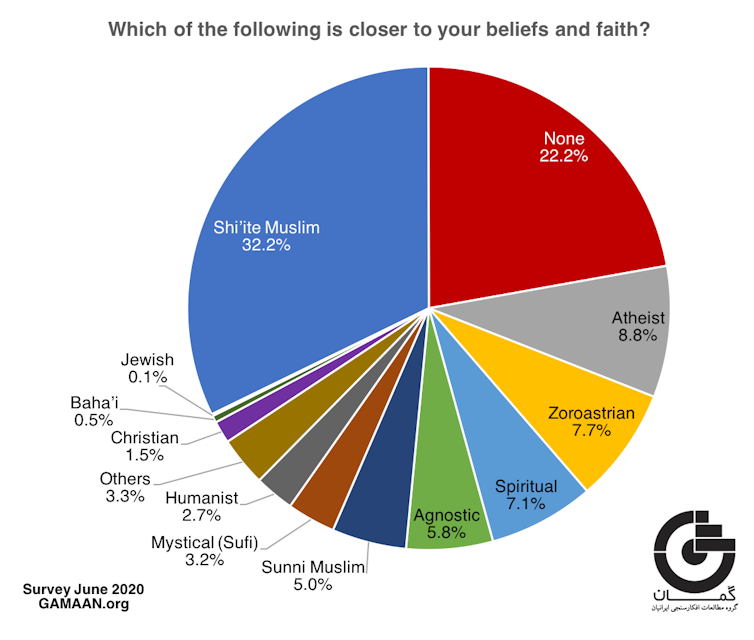
Our results reveal dramatic changes in Iranian religiosity, with an increase in secularisation and a diversity of faiths and beliefs. Compared with Iran’s 99.5% census figure, we found that only 40% identified as Muslim.
In contrast with state propaganda that portrays Iran as a Shia nation, only 32% explicitly identified as such, while 5% said they were Sunni Muslim and 3% Sufi Muslim. Another 9% said they were atheists, along with 7% who prefer the label of spirituality. Among the other selected religions, 8% said they were Zoroastrians – which we interpret as a reflection of Persian nationalism and a desire for an alternative to Islam, rather than strict adherence to the Zoroastrian faith – while 1.5% said they were Christian.
GAMAAN Religion in Iran 2020 – identifications.
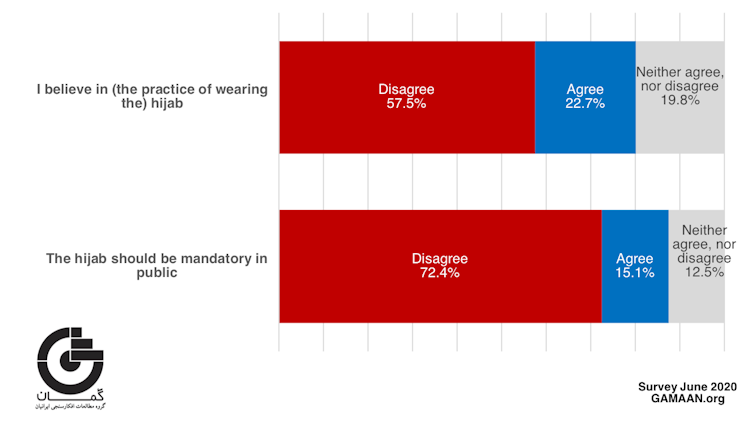
…We found that societal secularisation was also linked to a critical view of the religious governance system: 68% agreed that religious prescriptions should be excluded from legislation, even if believers hold a parliamentary majority, and 72% opposed the law mandating all women wear the hijab, the Islamic veil.
GAMAAN Religion in Iran 2020 – hijab….
Discover more from
Subscribe now to keep reading and get access to the full archive.